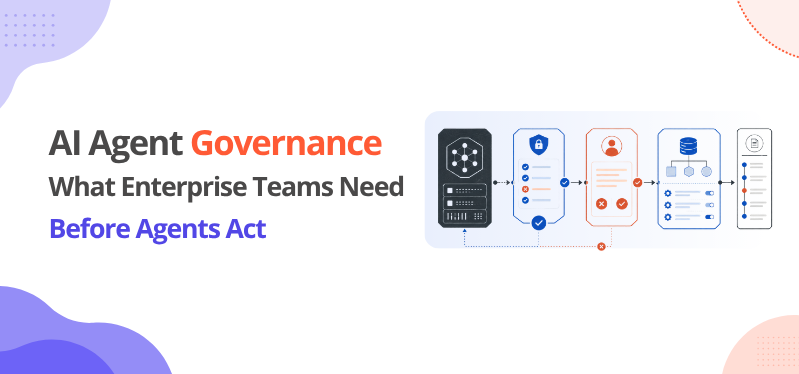
Short answer: AI agent governance is the operating model that keeps an agent’s authority proportionate to its purpose. Before an agent touches production systems, define its identity, scoped access, allowed actions, approval thresholds, monitoring, and audit record. The goal is not to make agents useless; it is to make autonomous work reviewable, reversible, and accountable.
What is AI agent governance?
AI agent governance is the set of decisions, technical controls, and operating practices that determine how an AI agent behaves inside an organization. It answers a more concrete question than broad AI policy: what may this agent do, with which data and tools, under whose authority, and how can we prove what happened?
This matters because agents can take actions, not merely generate text. A useful internal agent might triage an incoming request, look up a customer record, draft a response, open a ticket, or trigger a workflow. Each added capability expands the potential value—and the possible blast radius when access, instructions, or integrations are wrong.
Governance is therefore not a document that sits beside the agent. It is the control plane around the agent’s identity, permissions, execution, and evidence. Policies explain intent; runtime and delivery controls make that intent enforceable.
The six controls that make governance operational
A policy that says “use AI responsibly” is too vague for an agent connected to real systems. A usable governance model turns that principle into specific decisions.
| Control | Decision to make | Evidence to retain |
|---|---|---|
| Accountability | Name a business owner, a technical owner, and an approver for material changes. | Owner register, change history, and approval record. |
| Identity and access | Give the agent its own identity and only the credentials and data scopes required for its task. | Permission inventory and credential scope. |
| Action boundaries | List allowed tools and actions; explicitly exclude irreversible or high-impact actions until approved. | Action catalog and blocked-action rules. |
| Human approval | Set thresholds for when a person reviews a recommendation, a draft, or an action before it happens. | Approval decision, reviewer, and timestamp. |
| Monitoring | Watch quality, failures, unusual tool use, access denials, and business outcomes—not just model usage. | Operational logs, alerts, and review cadence. |
| Auditability | Record inputs, tools called, output, action result, and the policy or approval that authorized the work. | Searchable, retained activity trail. |
These controls apply to agents built in-house, purchased as part of a platform, or assembled through workflow tools. The implementation differs; the questions do not.
Use autonomy by consequence, not by novelty
The safest starting point is not “fully autonomous” or “human in every loop.” It is a graduated model: allow an agent to act independently only when the action is low-consequence, well-bounded, and easy to reverse.
- Assist: research, summarize, classify, or draft. A person remains the actor.
- Recommend: prepare a proposed next step with its supporting evidence. A person approves or rejects it.
- Act within a boundary: perform a predefined, reversible action—such as creating a draft ticket—with monitoring and an exception route.
- Escalate: hand off when confidence is low, data is sensitive, a policy condition is met, or the action would be hard to reverse.
Do not use a generic confidence score as the only approval rule. An action can be predicted with high confidence and still be inappropriate because it accesses sensitive data, changes a contract, approves payment, sends an external message, or creates a security obligation. Approval thresholds should reflect impact as well as uncertainty.
A rollout sequence that does not outrun governance
1. Start with a narrow, observable job
Choose one repetitive job with a clear input, a useful output, and a business owner. Map the systems it touches, the data categories involved, and the failure modes that would matter. Avoid beginning with “an agent that can do anything” across a shared toolset.
2. Design permissions before prompts
A prompt may describe an agent’s intent; credentials define its actual reach. Create an explicit list of tools, endpoints, data sets, and allowed operations. Use scoped credentials and avoid giving an agent a general human administrator account simply because it is convenient.
3. Define approval and exception paths
Specify what the agent can complete, what it can draft but not submit, and what must stop and escalate. Also define who is on the hook when the usual owner is unavailable. Governance that assumes a single reviewer is available at all times quickly becomes bypassed governance.
4. Test the edges, not only the happy path
Try incomplete inputs, conflicting instructions, unauthorized requests, stale data, unexpected tool responses, and attempts to widen scope. Test whether the agent stops, explains the limit, records the event, and routes the problem to a person.
5. Review the evidence after launch
Monitor the actions the agent actually takes, not just whether it stays online. Look for recurring exceptions, unnecessary access, repeated overrides, and changes in task quality. Those findings should change the permissions, workflow, or product—not simply create more documentation.
AI agent lifecycle governance: from inventory to retirement
Governance does not end at launch. AI agent lifecycle management is the discipline of governing each agent from its first proposal through provisioning, operation, change, and retirement. It prevents an organization from accumulating agents whose owners, permissions, and purpose are no longer clear—a common form of agent sprawl.
Keep a single inventory of sanctioned agents, including their owner, business purpose, identity, connected systems, data categories, approved actions, and current lifecycle status. An agent that cannot be found in the inventory should not be treated as a production capability, even if it appears to be useful.
| Lifecycle stage | Governance question | Minimum control |
|---|---|---|
| Discover and register | Why does this agent exist, and who is accountable for it? | Record the owner, purpose, risk tier, and intended users before access is granted. |
| Design and approve | What data, tools, and decisions does it need? | Approve a scoped action catalog, prohibited actions, and human escalation path. |
| Provision | What identity and credentials will it use? | Create a distinct agent identity and least-privilege credentials; do not share a human administrator account. |
| Deploy and monitor | Is it behaving within its approved boundary? | Log actions and outcomes, alert on exceptions, and retain evidence for review. |
| Recertify and change | Does its access still match its purpose after a model, prompt, integration, or workflow change? | Re-review permissions and approval thresholds on a defined cadence and after material changes. |
| Retire | What happens when the agent is replaced or no longer needed? | Disable the identity, revoke credentials, preserve required records, and remove it from active service. |
Lifecycle review is especially important when an agent gains a new integration, moves from drafting to acting, or is repurposed for a different team. Those are changes in delegated authority, not small configuration updates. Treat them as a reason to recheck the agent’s owner, boundaries, and evidence trail.
Action risk assessment matrix
Use a consistent authorization rule for each action type. The examples below are a starting point for a governance conversation, not a replacement for your own risk, legal, and security review.
| Agent action | Typical consequence | Default authorization |
|---|---|---|
| Read a permitted internal knowledge source | Low when the source and retrieval scope are already approved. | Bounded autonomy |
| Create a draft ticket or internal summary | Reversible; a person remains responsible for final use. | Bounded autonomy |
| Send an external message | Can create a customer, legal, or reputational commitment. | Human approval |
| Modify a customer or production record | May change an operational source of truth. | Human approval |
| Approve payment, contract, or privileged access | High consequence and difficult to reverse. | Do not delegate |
Govern the delivery path as well as the agent.
An agent’s behavior matters, but so does how the application around it is designed, reviewed, deployed, and changed. Dual7 connects rapid prototyping with a seven-stage governed delivery process, including human approval gates and an audit trail.
Where Dual7 fits in an AI agent governance program
Dual7 is a fit when a team needs to move an agent-enabled app from an early concept to a controlled production delivery process without rebuilding the project. Its AI Agent Builder supports conversational agents for shipped apps, with guardrails, scoped credentials, and monitoring. Its broader governed workflow takes features through requirements, plan, UX, schema, stories, build, and publish, with human approval checkpoints and a full audit trail.
For enterprise teams, the key question is not merely whether an agent can be created quickly. It is whether the application, access model, delivery history, and deployment can stand up to operational review. Dual7’s security approach describes tenant isolation, encryption in transit and at rest, human approval gates, and audit logging; Enterprise adds SSO/SAML and SCIM. Teams that need to run the final application on their own infrastructure can also export the React/Next.js, Node.js, and PostgreSQL codebase.
Dual7 is not a substitute for your organization’s risk owners, access-management program, incident process, or domain-specific compliance review. It provides a governed way to build and ship the app and agent experience; the business still needs to define acceptable authority and own the operating decisions around it. See Dual7 Enterprise for the relevant delivery and ownership context.
Governance review checklist
- Can we name the owner who is accountable for this agent’s outcomes?
- Can we list every system, action, and data category it can access?
- Which actions are autonomous, which require approval, and which are prohibited?
- Can a reviewer reconstruct why the agent made a recommendation or action?
- Can we stop access, revoke credentials, and recover from an incorrect action?
- Do we have a recurring review based on observed behavior and exceptions?
Frequently asked questions
Is AI governance the same as AI agent governance?
They overlap, but agent governance is more operational. Broad AI governance may cover model procurement, fairness, privacy, and organizational policy. Agent governance adds delegated action, tool access, approvals, and the evidence needed to review work performed in production.
Do all agents need human approval?
No. Requiring approval for every low-risk action can destroy the value of automation. Use approval where consequence, sensitivity, uncertainty, or irreversibility makes independent action inappropriate. Keep autonomy narrow at first and expand it with evidence.
What is the first governance artifact to create?
Create an agent charter: the job it performs, its business owner, systems and data it can access, allowed and prohibited actions, approval thresholds, and the measures used to judge its quality. It makes gaps visible before integration work begins.
Can we adopt a platform and skip governance design?
No. A platform can provide helpful controls, but it cannot decide your organization’s acceptable authority, data boundaries, or accountability model. Treat platform capabilities as ways to implement your decisions, not as a replacement for them.
Article Authors

More posts from this author
Related posts