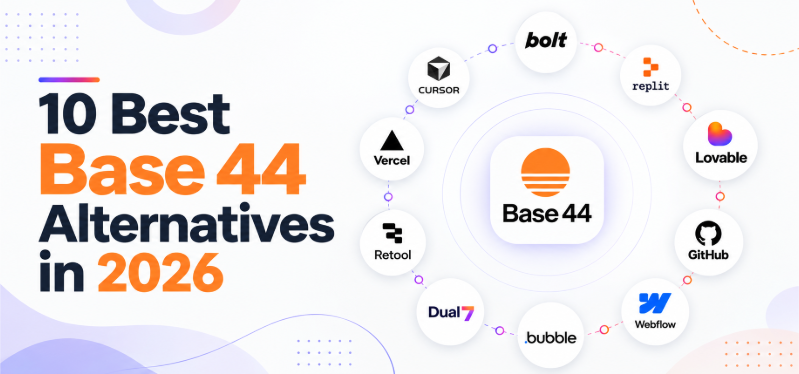
- The best Base44 alternatives for 2026 include Dual7, Lovable, Cursor, Claude Code, Dyad, Bolt.New, Replit Agent, v0, Bubble, and Zite. Each of these have strong in a different mix of prompt-driven speed, code ownership, and production readiness.
- Dual7 is a governed AI app-building platform that runs fast, prompt-driven iteration and a staged, audited path to production on the same codebase.
- Lovable and Cursor suit different kinds of technical maturity: Lovable as a prompt-first builder for non-technical founders and Cursor as a professional-grade AI IDE for engineers already shipping software.
- Claude Code and Dyad are good for infrastructure-agnostic builds. Claude Code as a terminal-based agent for existing codebases, Dyad as a free, local-first, open-source builder for privacy- and cost-conscious teams.
Millions of founders, product managers, and solo builders have used Base44 to turn a prompt into a working prototype before lunch.
But a growing number of those same builders are hitting the same wall: the backend Base44 generates for you is also the backend you can't take with you. As teams move past the first demo and start thinking about real users, real data, and real uptime. With this, the question often becomes: what are some Base44 alternatives to help my team build this? In this article, we’ll cover a comprehensive overview of the best Base44 alternatives on the market and what they work best for.
What is Base44, and who is it actually for?
Base44 is a managed, prompt-driven application builder that converts natural-language descriptions into full-stack web apps, with database, authentication, file storage, and hosting included, all abstracted away from the user. Wix acquired it in mid-2025 for roughly $80 million, and it now serves more than two million registered users as part of Wix's broader product portfolio.
- Base44’s USP was speed: a dual-chat system separates free planning Discuss Mode from billable generation Code Mode, and a visual editor lets non-technical users tweak layouts without touching code.
- That said, limitations show up once an app needs custom business logic, complex state management, or backend code that lives outside Base44's own servers.
- Also, usage-based credit consumption can compound the problem, since a single automated debugging loop can quietly exhaust a month's allowance.
Top 10 Base44 alternatives in a gist
Here's a quick-scan summary of each alternative before the detailed breakdown below.
1.Dual7
A governed AI app-building platform that runs fast, prompt-driven Vibe Mode iteration and a seven-stage Governed Mode approval pipeline on the same codebase, so features move toward production without a rebuild.
| Pros | Cons |
|---|---|
| – Full code and infrastructure ownership from day one– Enterprise controls (SSO/SAML, SCIM, RBAC, row-level security) built in | – Still in early access, with a smaller ecosystem– SOC 2 Type II and ISO 27001 are in progress, not complete |
2. Lovable
The closest match to Base44's prompt-first experience. This Base44 alternative comes with one key difference: what it builds, you keep, via standard React/TypeScript code on a Supabase backend you control.
| Pros | Cons |
|---|---|
| – Zero vendor lock-in once exported to GitHub and Supabase– Strong choice for non-technical founders who want production-ready code | – Credit consumption can spike during design iteration or debugging loops– Complex backend logic and Supabase security rules still benefit from technical oversight |
3. Cursor
An AI-native fork of VS Code built for professional engineers who already have a codebase and want an AI layer that understands it, rather than an app generated from a blank prompt.
| Pros | Cons |
|---|---|
| – Dramatically increases developer throughput on existing, complex codebases– Zero vendor lock-in — code lives on local drives and standard Git repos | – Requires programming knowledge; it's an editor, not an app generator– The 2026 SpaceX acquisition has introduced uncertainty around model access |
4. Claude Code
An agentic, terminal-based coding tool from Anthropic that works directly on your own codebase and infrastructure instead of a managed sandbox.
| Pros | Cons |
|---|---|
| – Works on real, existing codebases, not just greenfield prompts– No platform lock-in; code, database, and hosting stay entirely up to you | – Terminal-based workflow has a learning curve for visual-builder users– No built-in database, auth, or hosting layer |
5. Dyad
A free, open-source, local-first app builder that runs entirely on your own machine, connecting via your own API keys or local models like Ollama.
| Pros | Cons |
|---|---|
| – Zero lock-in and no platform credit markups– Full data privacy — nothing leaves your machine unless you choose a cloud model | – Requires managing your own API keys or local model setup– Less turnkey for complete non-coders than a managed builder |
6.Bolt.new
A browser-based full-stack builder that runs a real Node.js environment via WebContainers, giving developers full visibility into files, terminal logs, and package installs.
| Pros | Cons |
|---|---|
| – Full file-system access and transparency for developers who dislike black boxes– Zero vendor lock-in; projects export to GitHub or a local drive | – Token consumption can climb fast during extended debugging– Non-technical founders may find raw terminal errors hard to resolve alone |
7. Replit Agent
A browser-based cloud IDE and agent that plans, codes, tests, and deploys full-stack apps directly onto managed cloud virtual machines.
| Pros | Cons |
|---|---|
| – Fully browser-based, with no local environment to configure– Flat Pro-tier pricing supports up to 15 builders on one plan | – Effort-based credit pricing can burn through a monthly allowance quickly– Maintainability declines on large, multi-file projects as they scale |
8. v0 (by Vercel)
A design-to-code generator focused almost entirely on the frontend, converting prompts, screenshots, and wireframes into production-grade React components.
| Pros | Cons |
|---|---|
| – Industry-standard tool for scaffolding polished, accessible UI components– Generated code is portable, not trapped in a proprietary editor | – Primarily a frontend tool; backend/database logic needs a separate service– Complex generation requests can burn through free-tier credits fast |
9.Bubble
A visual-first, no-code builder that predates the current AI app-builder wave, trading prompt-driven speed for a drag-and-drop workflow editor and granular control.
| Pros | Cons |
|---|---|
| – Handles complex, multi-role workflows better than most prompt-first builders– A decade-plus track record with a large plugin ecosystem and community | – No traditional source-code export; apps stay dependent on Bubble's infrastructure– Usage-based workload pricing and a steeper learning curve |
10. Zite
A business-app builder that generates workflows from a prompt like Base44 does, but exposes backend logic as an editable flowchart with production infrastructure built in.
| Pros | Cons |
|---|---|
| – Production concerns like SOC 2 Type II and access controls come built in– Flat, predictable pricing with unlimited users on every plan | – No source-code export; apps remain on Zite's own infrastructure– Web apps only, with no native mobile export |
Why should you look for a Base44 alternative?
Base44 popularized prompt-to-app speed, but its managed, all-in-one architecture creates a few recurring problems once teams move past the first demo:
- To avoid the backend lock-in: Frontend code exports on paid tiers, but the database, authentication, and backend logic stay tied to Base44's own infrastructure. This means reaching product-market fit can mean a near-complete rewrite to establish independent infrastructure.
- To move away from credit-based pricing: Base44 bills through a dual-bucket system of message credits and integration credits, and an automated debugging loop can quietly burn a month's allowance in hours.
- Solving the 80/20 production barrier Base44 has: AI app generators reliably deliver the first 80% of an interface and basic CRUD logic in minutes. The remaining 20%, like edge cases, custom business logic, integrations, and compliance, is where prompt-iteration loops and platform ceilings tend to appear.
- Unlocking the full technical-maturity spectrum: From governed platforms like Dual7 to professional tools like Cursor and Claude Code, to local-first, privacy-first options like Dyad, teams can match the tool to their actual technical maturity instead of accepting one-size-fits-all trade-offs.
Detailed comparison of Base44's top alternatives
The alternatives below fall into distinct categories rather than one interchangeable group. Dual7 is a top Base44 alternative thaat combines fast AI-assisted building with a governed path to production on the same codebase. Cursor and Claude Code are professional-grade tools for engineers who already ship software. Lovable, Bolt.new, and Replit sit closer to Base44's own prompt-to-app category, but each handles code ownership differently.
| Platform | Core focus | Best for | Main drawback |
|---|---|---|---|
| Dual7 | Governed AI app building | Startups needing a path to production | Early access |
| Lovable | Prompt-to-app generation | Non-technical founders wanting ownership | Credit usage can spike |
| Cursor | AI-native IDE | Professional engineering teams | Not an app builder |
| Claude Code | Agentic coding | Engineers extending existing codebases | No built-in hosting or database |
| Dyad | Local, open-source app builder | Privacy- and cost-conscious builders | Requires managing your own API keys |
| Bolt.new | Browser-based full stack | Developers wanting transparency | Token burn on debugging |
| Replit Agent | Cloud dev environment | Rapid prototypes & IT teams | Unpredictable credit burn |
| v0 | UI generation | Frontend-first teams on Vercel | Backend needs separate setup |
| Bubble | No-code visual app builder | Complex, workflow-heavy apps | No code export |
| Zite | Business app builder | Ops teams needing production apps fast | No code export or native mobile |
1.Dual7
Dual7 is built for teams who like Base44's speed but don't want to hit its ceiling. Instead of choosing between fast prototyping and long-term ownership.
This Base44 alternative runs both on the same project: Vibe Mode for rapid, prompt-driven iteration, and Governed Mode, a seven-stage pipeline with approval gates that moves features toward production without a rebuild.
Best for: Startups and regulated teams that want a fast MVP path with an audited, governed route to production.
- Two modes, one codebase: Switch between Vibe Mode iteration and Governed Mode's staged approval workflow without starting over.
- Full code and infrastructure ownership: Apps run on your own Git repository, database, and cloud infrastructure, with exportable source code from day one.
- Apps and agents, web and mobile: Build Next.js and React web apps plus Expo mobile apps on PostgreSQL, alongside AI agents across WhatsApp, Slack, SMS, and voice.
| Pros | Cons |
|---|---|
| – The same project can move from rapid prototyping to governed, audited production without a rewrite– Enterprise controls like SSO/SAML, SCIM, RBAC, and row-level security are built in rather than bolted on | – Still in early access, so its ecosystem is smaller than platforms that have been around for years |
2. Lovable
Founded in Stockholm in November 2023, Lovable has scaled to roughly $200 million in annual recurring revenue by generating clean React, TypeScript, and Tailwind CSS frontend code. This skill set is paired with a native Supabase backend database, auth, edge functions, and storage, all on infrastructure you control.
Best for: Non-technical founders building commercial SaaS MVPs who need production-ready code without hiring engineers first.
- Standard, exportable code: No proprietary runtime; output is plain React and TypeScript any developer can pick up.
- Native Supabase backend: Database, authentication, edge functions, and storage run on infrastructure you control.
- Bi-directional GitHub sync: Edit the generated repository locally while staying in sync with the Lovable Agent.
| Pros | Cons |
|---|---|
| – Zero vendor lock-in once code is exported to GitHub and Supabase– A strong choice for non-technical founders who need production-ready code without hiring engineers first | – Credit consumption can spike quickly during design iteration or automated debugging loops– Complex backend logic and configuring Supabase row-level security still benefit from technical oversight |
One G2 reviewer noted that more complex projects still required manual changes and a few extra prompts to reach the desired result — a common pattern across every AI builder in this list, not unique to Lovable.
3.Cursor
Cursor isn't trying to be Base44. It's an AI-native fork of VS Code built for professional engineers who already have a codebase and want an AI layer that understands it. Following SpaceX's acquisition of parent company Anysphere in a deal that closed in mid-2026, Cursor indexes entire repositories to make precise, multi-file changes rather than generating an app from a blank prompt.
Best for: Professional software engineers and teams working inside complex, existing codebases.
- Codebase-aware editing: Vectorized repository indexing retrieves precise context across thousands of local files.
- Composer agent: Executes autonomous multi-file edits, terminal commands, and test runs based on compiler output.
- Multi-model routing: Routes requests across frontier models so teams aren't locked into a single provider.
| Pros | Cons |
|---|---|
| – Dramatically increases developer throughput on existing, complex codebases– Zero vendor lock-in: code lives on local drives and standard Git repositories | – Requires programming knowledge; it's an editor, not an all-in-one app generator– The SpaceX acquisition has introduced some uncertainty around third-party model access going forward |
4. Claude Code
Claude Code takes a fundamentally different approach from Base44: instead of generating an app inside a managed platform, it's an agentic coding tool that lives in the terminal and works directly on your own codebase and infrastructure.
Built by Anthropic, the Base44 alternative is aimed at developers who want an AI collaborator that can plan, write, and execute multi-step changes without leaving the command line.
Best for: Engineers extending or maintaining an existing production codebase.
- Terminal-native agent: Reads a codebase, plans multi-step changes, and executes shell commands and file edits directly.
- Deep git integration: Works inside existing repositories and CI/CD pipelines rather than a proprietary sandbox.
- Bundled into Claude plans: Available through Claude's Pro and Max subscriptions, plus Team and Enterprise tiers with usage-based API pricing.
| Pros | Cons |
|---|---|
| – Works on real, existing codebases rather than only greenfield prompt-to-app projects– No platform lock-in: code, database, and hosting choices remain entirely up to the developer | – The terminal-based workflow has a learning curve for developers used to visual, drag-and-drop builders– Provides no built-in database, authentication, or hosting layer, so non-technical founders need a developer to get value from it |
5. Dyad
Dyad is an open-source, local-first AI application builder created to address vendor lock-in, credit markups, and data-privacy risk in cloud platforms.
It runs entirely on your own Mac or Windows machine, connecting to models via your own API keys (Anthropic, OpenAI, OpenRouter) or fully offline through tools like Ollama, and has grown to more than 20,000 GitHub stars.
Best for: Privacy-conscious developers, open-source advocates, and cost-sensitive founders who want to eliminate credit markups entirely.
- Fully local execution: Runs on your desktop with no cloud telemetry or platform lock-in.
- Bring-your-own model: Connects to major API providers or fully offline local models via Ollama and LM Studio.
- Native Supabase connection: Handles authentication, database management, and serverless edge functions alongside built-in OWASP and SQL-injection scanning.
| Pros | Cons |
|---|---|
| – Zero lock-in; code is generated and stored locally on your own system– Eliminates platform credit markups entirely — you pay only for the API tokens you use, or nothing at all with a local model | – Requires managing your own API keys or local model setup, which adds friction for complete non-coders– Smaller, community-driven support model compared to venture-backed platforms |
6.Bolt.new
Bolt.new, built by StackBlitz, runs full Node.js environments directly inside the browser using WebContainers technology. Where Base44 abstracts the entire backend away, Bolt.new gives developers full visibility into terminal logs, package installs, and directory structures while still generating a complete application from a prompt.
Best for: Developers who want a transparent, in-browser full-stack environment rather than a black-box builder.
- In-browser Node.js runtime: Executes npm packages, terminal commands, and dev servers without local setup.
- Figma-to-code: Converts design files directly into full-stack application code.
- Framework flexibility: Supports Vite, React, Vue, Svelte, Next.js, and Node/Express projects.
| Pros | Cons |
|---|---|
| – Full file-system access and transparency appeal to developers who don't want a black-box builder– Zero vendor lock-in; projects export cleanly to GitHub or a local drive | – Token consumption can climb quickly on large codebases or extended debugging sessions– Non-technical founders may find terminal errors harder to resolve without developer help |
7. Replit Agent
Replit Agent takes the opposite approach from a terminal tool: everything happens inside a browser-based cloud IDE, including the virtual machine your app runs on. This Base44 alternative plans, codes, tests, and deploys full-stack applications on managed cloud infrastructure, making it a strong fit for teams that want Base44's zero-setup feel with more room to grow.
Best for: Rapid prototyping and internal IT teams that want a fully managed, browser-based build-and-deploy workflow.
- Managed cloud VMs: Every project runs on a hosted virtual machine with attached databases and deployment built in.
- Parallel agents: Paid tiers support multiple agents working on different parts of a project at once.
- Flat team pricing: The Pro tier supports up to 15 builders under one flat monthly fee.
| Pros | Cons |
|---|---|
| – Fully browser-based, so there's no local environment to configure– Source code can be downloaded or exported to GitHub rather than staying fully locked in | – Effort-based credit pricing can burn through a monthly allowance quickly during agent error loops– Performance and maintainability can decline on large, multi-file projects as they scale |
8.v0 (by Vercel)
v0, built by Vercel, focuses on the one part of the stack Base44 treats as an afterthought: the frontend. This Base44 competitor converts prompts, screenshots, and wireframes directly into production-grade React components, and rebranded from v0.dev to v0.app in early 2026 as it expanded from UI generation toward fuller application workflows.
Best for: Frontend developers and designers already working inside the Vercel ecosystem.
- Design-to-code generation: Converts uploaded screenshots or mockups into functional React components.
- Modern frontend stack: Outputs React, Tailwind CSS, and shadcn/ui components that plug into existing repositories.
- One-click Vercel deployment: Ships directly to Vercel's infrastructure with GitHub sync included.
| Pros | Cons |
|---|---|
| – An industry-standard tool for scaffolding polished, accessible UI components quickly– Generated code is portable rather than trapped inside a proprietary editor | – Primarily a frontend tool; backend and database logic need a separate service like Supabase– Complex generation requests can consume free-tier credits quickly, pushing active projects to a paid plan |
9.Bubble
Bubble takes a visual-first approach that predates the current wave of AI app builders. Instead of generating an app from a single prompt, it gives users a drag-and-drop workflow editor with a built-in database, authentication, and a large plugin ecosystem, trading prompt-driven speed for granular visual control.
Best for: Non-technical teams and agencies building complex, workflow-heavy web applications with bespoke logic.
- Visual drag-and-drop builder: Design interfaces and define complex workflow logic without writing raw code.
- Massive plugin ecosystem: Connect to thousands of pre-built integrations, templates, and API connectors.
- Built-in backend & database: Handles data models, privacy rules, user authentication, and scheduled tasks natively.
| Pros | Cons |
|---|---|
| – Handles complex, multi-role workflows better than most prompt-first builders– A decade-plus track record with a large community, marketplace, and talent pool | – No traditional source-code export; apps remain completely bound to Bubble's infrastructure– Usage-based workload unit pricing can become expensive and hard to forecast at scale |
10. Zite
Zite is a business-app builder designed for operations and internal IT teams. Zite generates workflows from a prompt like Base44 does, but exposes backend logic as an editable flowchart with production-grade access controls and compliance infrastructure built in from day one.
Best for: Ops teams and corporate IT departments building mission-critical internal apps fast.
- Flowchart-based backend logic: Inspect and edit AI-generated workflows visually without touching raw code.
- Enterprise governance: Includes SOC 2 compliance, audit logs, and fine-grained access management out of the box.
- Predictable flat pricing: Offers unlimited user seats across plans without per-seat penalties.
| Pros | Cons |
|---|---|
| – Production concerns like SOC 2 Type II and granular access controls come built in– Flat, predictable pricing with unlimited users on every plan | – No source-code export; apps remain hosted on Zite's proprietary infrastructure– Focused on web applications with no support for native mobile app compilation |
How to choose the right Base44 alternative for your team
To avoid switching to a platform that presents the same hidden bottlenecks, evaluate alternatives across four primary criteria:
- Code & Infrastructure Ownership: Do you need full access to standard frontend and backend code (React, Node.js, SQL), or are you comfortable with hosted runtime dependencies? Tools like Dual7, Lovable, Dyad, and Cursor ensure zero lock-in.
- Team Technical Maturity: Non-technical founders will find Lovable or Dual7's Vibe Mode the easiest transition from Base44. Developers working on existing products will gain far more efficiency from Cursor or Claude Code.
- Production Readiness & Governance: If your software must pass enterprise security reviews, audit trails, and strict RBAC checks, look for governed platforms like Dual7 or enterprise builders like Zite.
- Pricing Predictability: Compare raw token/credit markups against flat monthly tiers. Platforms like Dyad (BYO API key) or Dual7 (with credit rollover options) protect against runaway debugging bill shocks.
Dual7: The Best Base44 Alternative Overall
Compared to all the alternatives on this list of Base44 alternatives, Dual7 a more structured path. As a vibe coding tool, its biggest advantage is that speed, code ownership, security, and governance are built into the same development lifecycle.
- Build fast, ship properly: Dual7 combines rapid AI-powered prototyping with a governed production workflow on the same codebase.
- Own your code: Applications are delivered as clean React, Node.js and PostgreSQL code that can be exported to GitHub and deployed independently.
- Enterprise-ready security: Multi-tenancy, Row-Level Security (RLS), RBAC and secret isolation are built into the development process.
- Seven-stage governance: Human approval gates across requirements, architecture, UX, schema, testing and deployment reduce risky AI-generated changes.
- Web + mobile: A unified codebase supports Next.js web applications and native iOS/Android apps through Expo.
Ready to build without giving up control of your application? See what Dual7 can do for your team!
Frequently asked questions
What is the best free Base44 alternative?
Dyad is the top free, open-source alternative for builders willing to bring their own API keys or run local models via Ollama. Dual7, Lovable, Bolt.new, and v0 also offer free tiers for testing and sandboxed prototyping.
Can I export my backend code out of Base44?
No. Base44 allows frontend code exports on paid plans, but its database, authentication, and serverless backend logic remain locked to Base44's managed cloud runtime.
Which alternative is best for non-developers who want full code ownership?
Lovable and Dual7 are the strongest choices. Both allow non-technical builders to generate full-stack web applications using plain-English prompts while exporting clean, standard source code directly to GitHub and external databases.
How does Dual7 differ from other prompt-to-app builders?
Dual7 uniquely combines rapid prompt-driven generation ("Vibe Mode") with a seven-stage governed approval pipeline ("Governed Mode") on the exact same codebase, ensuring apps can scale from a prototype to procurement-ready software without a rewrite.
Article Authors

More posts from this author
Related posts