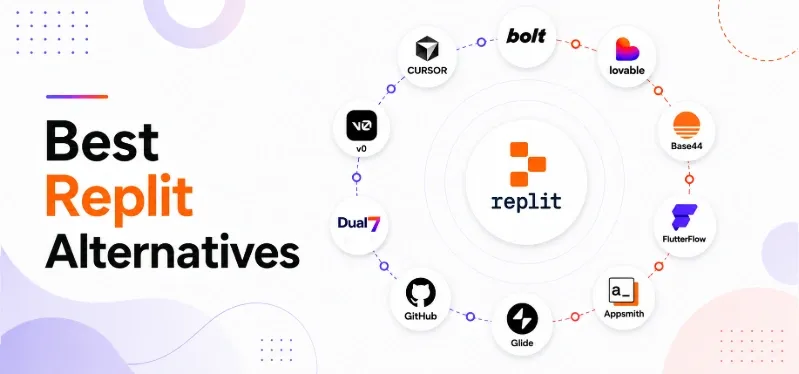
Replit alternatives help you when your app needs a different workflow than a browser-based AI coding environment. I reviewed current first-party product pages, pricing, deployment documents, integration details, and limits on August 13, 2026. I selected tools for category fit, intended buyer, deployment path, technical control, integrations, pricing model, and the reason a Replit buyer might consider a different option. AI-generated code can still contain bugs, so every tool needs prompt iteration, testing, and review before a real-use case goes live.
Replit Agent and its deployment products provide a strong integrated route from an idea to a published app. A buyer may still want a different fit for governed delivery, a visual mobile app, a self-hosted internal tool, a data-led business app, or AI help inside an existing codebase. The ten alternatives below are not a universal ranking. Each one is a better fit for a particular job.
| S No | Alternative | Best for | Starting price | Production-ready |
|---|---|---|---|---|
| 1 | Dual7 | Governed AI app delivery | USD $0 Free; Starter USD $15/month | Yes, documented governed-production path |
| 2 | Lovable | Prompt-led web apps with managed backend | USD $0 Free; Pro USD $25/month | Yes, publish and custom domains documented |
| 3 | Bolt.new | Browser-first web apps and prototypes | USD $0 Free; Pro USD $25/month | Yes, hosting and custom domains documented |
| 4 | v0 | Vercel and GitHub web workflows | USD $0 Free; Plus USD $30/user/month | Yes, Vercel production deployments documented |
| 5 | Base44 | Prompt-led apps with built-in backend | USD $0 Free; Starter USD $16/month billed annually | Yes, hosting and domains publicly described |
| 6 | FlutterFlow | Visual cross-platform mobile apps | USD $0 Free; Basic USD $39/month | Yes, web and app-store deployment documented |
| 7 | Appsmith | Self-hosted internal tools | USD $0 Free; Business USD $15/user/month | Yes, production Kubernetes path documented |
| 8 | Glide | Data-led business apps | USD $0 Free | Yes, deployed business-app path; export details not publicly listed |
| 9 | Cursor | AI help inside an existing codebase | USD $0 Hobby; Pro USD $20/month | not publicly listed; use separate hosting |
| 10 | GitHub Copilot | GitHub and pull-request workflows | USD $0 Free; Pro USD $10/user/month | not publicly listed; use separate hosting |
1. Dual7
What does Dual7 do?
Dual7 is an AI app-building product with Vibe Mode for fast creation and a governed path for work that needs more control. Its public materials describe owned code, governance, and enterprise delivery.
Who is Dual7 for?
It fits teams that want to move from a prompt-led build into a more controlled delivery workflow. The enterprise material is most relevant when governance and code ownership are part of the buying decision.
Where does Dual7 differ from Replit?
Replit provides an integrated browser-based Agent and deployment workflow. Dual7 is the better-fit option when the buyer specifically wants a separation between fast building and governed production delivery.
The Free plan is USD $0 with 50 credits each month. Starter is USD $15/month with 150 credits, and export starts at Starter. Credits are not directly comparable to other vendors' tokens or messages.
| Dual7 pros | Dual7 cons |
|---|---|
| A public workflow for fast building followed by governed delivery. | Code export does not start on the free plan. |
2. Lovable
What does Lovable do?
Lovable is a prompt-led web-app builder. Lovable Cloud includes hosting, a database, authentication, storage, edge functions, and AI.
Who is Lovable for?
It fits people and small teams that want to build and host a web app without setting up each backend service themselves. Its plan guidance distinguishes smaller Free projects from faster-moving Pro workspaces.
Where does Lovable differ from Replit?
It is a useful Replit alternative when a buyer wants managed web-app services and a publish flow inside one prompt-led product. Replit is still a strong fit for an all-in-one coding workspace and deployment path.
Lovable has a Free plan. Pro is USD $25/month for 100 monthly credits, or USD $250 annually, shown as a USD $21/month equivalent. It documents published URLs, access control, custom domains, and HTTPS hosting.
| Lovable pros | Lovable cons |
|---|---|
| Managed backend services and hosting are part of the product. | Direct codebase download is documented as a paid-plan feature. |
3. Bolt.new
What does Bolt.new do?
Bolt.new is an AI builder for websites, apps, and prototypes. Its Bolt Cloud material describes hosted databases and integrations alongside the builder.
Who is Bolt.new for?
It fits product managers, marketers, students, and builders who want to make a browser-first app or prototype with a built-in publish path.
Where does Bolt.new differ from Replit?
Bolt is a good match when a Replit buyer wants a prompt-led product with hosting, a free bolt.host URL, custom domains, and GitHub sync. The workflow remains close to the browser-first model that makes Replit attractive.
The Free plan is USD $0. Pro is USD $25/month billed monthly. Bolt says yearly billing can save up to 28%, but its exact annual plan price was not verified. Its free token caps are 300K daily and 1M monthly, which are not comparable to credit plans.
| Bolt.new pros | Bolt.new cons |
|---|---|
| Hosting, publishing, custom domains, and GitHub sync are documented. | Free use has daily and monthly token caps and includes Bolt branding. |
4. v0
What does v0 do?
v0 is Vercel's AI product for designing, iterating on, and scaling full-stack web apps. Its GitHub workflow supports branch and pull-request work.
Who is v0 for?
It fits web teams that already prefer Vercel and GitHub, or that need a clear route from AI-generated work to a production deployment and review process.
Where does v0 differ from Replit?
v0 is the more direct fit than Replit when Vercel production, GitHub branches, and pull requests are central to the team's delivery workflow.
The Free plan is USD $0 with USD $5 monthly credits. Plus is USD $30/user/month with USD $30 included monthly credits per user. Its deployment documentation covers Vercel production URLs, CDN delivery, and deployment settings.
| v0 pros | v0 cons |
|---|---|
| Documented Vercel production and GitHub review workflow. | Generation pauses when included credits run out unless on-demand credits are added. |
5. Base44
What does Base44 do?
Base44 is a vibe-coding platform for building apps and websites. Its public product page describes a built-in backend, hosting, domains, and two-way GitHub sync.
Who is Base44 for?
It fits a buyer who wants an AI app builder with managed backend and hosting features in the same product, plus a GitHub connection.
Where does Base44 differ from Replit?
It is a viable Replit alternative for prompt-led apps when the buyer prefers Base44's managed backend and GitHub-sync model. Compare the specific deployment and code-control needs before choosing.
Base44 has a USD $0 Free plan. Its Starter plan is USD $16/month billed annually with 100 message credits. Message credits cannot be compared directly with Replit usage or other vendors' token and credit systems.
| Base44 pros | Base44 cons |
|---|---|
| The public product page groups backend, hosting, domains, and GitHub sync together. | The paid entry plan uses message credits, which are not a cross-vendor capacity measure. |
6. FlutterFlow
What does FlutterFlow do?
FlutterFlow is a visual builder for mobile, web, and desktop apps. Its product page describes Firebase, Supabase, REST API, device-testing, and code-export paths.
Who is FlutterFlow for?
It is the strongest fit in this list for designers and product teams building a cross-platform or native mobile app with visual controls.
Where does FlutterFlow differ from Replit?
Replit is a general browser-based coding and deployment environment. FlutterFlow is the better fit when visual mobile workflows, app-store delivery, and downloadable source or APK files are the core needs.
The Free plan includes up to two projects and 10 Lite credits. Basic is USD $39/month and adds code and APK download, custom domains, and store deployment. Its web publishing docs cover subdomains, custom domains, and deployment history.
| FlutterFlow pros | FlutterFlow cons |
|---|---|
| Visual cross-platform work with documented code export and store deployment. | Free is limited to two projects and code download starts at Basic. |
7. Appsmith
What does Appsmith do?
Appsmith is an open-source low-code platform for internal tools that connect to databases, SaaS products, REST APIs, and GraphQL. It supports Git, CI/CD, and self-hosting.
Who is Appsmith for?
It fits engineering and operations teams that need internal business apps with infrastructure control, data connections, and a self-hosted option.
Where does Appsmith differ from Replit?
Appsmith is a clearer fit than Replit for an internal-tool program that needs a self-hosted production path and direct infrastructure ownership rather than an all-in-one hosted coding workspace.
The Free plan supports up to five users. Business is USD $15/user/month billed monthly. Its installation guides include Kubernetes guidance for production-grade autoscaling, load balancing, and high availability.
| Appsmith pros | Appsmith cons |
|---|---|
| Git, CI/CD, and self-hosted deployment options are publicly documented. | The free plan has a five-user cap and self-hosting requires a team to operate infrastructure. |
8. Glide
What does Glide do?
Glide makes data-led business apps from spreadsheets, data sources, and AI-assisted workflows. Its homepage focuses on turning operational data and ideas into apps.
Who is Glide for?
It fits an operations, sales, or service team that needs a business app based on existing data more than a custom codebase.
Where does Glide differ from Replit?
Glide is the better Replit alternative when the work begins with business data and an operational workflow. Replit is more appropriate when the buyer needs a coding environment and broad programming control.
The Free plan is USD $0 for one project with limited credits. A detailed custom-code export path is not publicly listed, so it should not be assumed in a migration plan.
| Glide pros | Glide cons |
|---|---|
| A quick path from operational data to a deployed business app. | The free plan is one project with limited credits, and export details are not publicly listed. |
9. Cursor
What does Cursor do?
Cursor is a developer AI coding agent that can edit files and run terminal commands. Its Cloud Agents run in isolated VMs, can test browser flows, and can attach artifacts to pull requests.
Who is Cursor for?
It fits developers and professional teams that already own a codebase and want agent help inside an IDE, terminal, and review workflow.
Where does Cursor differ from Replit?
Cursor is a better Replit alternative when the buyer already has a local or Git-hosted codebase and needs an AI assistant for direct coding work. It is not a hosted app platform.
The Hobby plan is USD $0. Pro is USD $20/month or USD $16/month billed yearly. Public application hosting is not publicly listed, so teams need a separate deployment provider.
| Cursor pros | Cursor cons |
|---|---|
| Focused agent workflow across an editor, terminal, cloud VMs, and pull-request verification. | Model use can exceed included allowance and be billed as on-demand usage. |
10. GitHub Copilot
What does GitHub Copilot do?
GitHub Copilot is an AI coding assistant across IDEs, GitHub, and the command line. Its cloud agent can research a repository, make changes in a branch, and prepare a pull request.
Who is GitHub Copilot for?
It fits teams that already work in GitHub and want AI help inside their existing repositories, coding tools, and pull-request reviews.
Where does GitHub Copilot differ from Replit?
GitHub Copilot is the better Replit alternative when the buyer does not need a new hosted development platform. It adds assistance to a GitHub-based engineering workflow instead.
The Free plan is USD $0. Pro is USD $10/user/month. Managed application hosting is not publicly listed, so a separate deployment provider is required. GitHub says Copilot does not replace developers and output should be tested, reviewed, and security-checked.
| GitHub Copilot pros | GitHub Copilot cons |
|---|---|
| Fits GitHub repositories, branches, and pull-request workflows. | It is an assistant rather than a hosting platform, and GitHub requires human review of output. |
Which Replit alternative app is cheapest?
There is no fair overall price winner because the products charge for different things. GitHub Copilot Pro is the lowest listed monthly starting price in this group at USD $10/user/month. Appsmith Business and Dual7 Starter each start at USD $15/month or per user. Base44 Starter is USD $16/month when billed annually. Lovable also has a USD $5/month Lite maintenance tier, but its included usage does not match Pro. Free plans do not make the tools equivalent. Credits, messages, tokens, users, hosting, and code-control terms vary, so compare the plan that matches your actual workflow.
Which Replit alternative should you choose?
You're a solo non-developer founder
Lovable is the best starting point when you want to describe a web app, use managed backend services, and publish without assembling infrastructure. Its paid code download requirement is the trade-off. If export and a governed handoff matter early, compare it with Dual7 before you build too much.
You're a digital marketing manager at a typical B2B SaaS company
Bolt.new is a practical fit for fast campaign tools, interactive prototypes, and small web apps. It has publishing, custom domains, and GitHub sync. Watch token limits and have an engineer review anything that handles customer data or becomes part of a core product.
You're a marketing consultant working with mid-sized companies
Dual7 is a strong fit when you need to show a concept quickly and then hand off a more governed version to a client team. Use the pricing and export terms to decide when to move from a free experiment to Starter. The trade-off is that it is a distinct platform workflow, not an assistant inside the client's existing repository.
You're a budding developer who wants to get hands-on with vibe coding
Cursor is the best fit when your goal is to learn inside an actual codebase. Its agent can edit files, run commands, and help test flows. You will need to choose and operate a separate hosting path, which is useful practice but requires more setup than a fully hosted builder.
You're a designer with Figma files
FlutterFlow is the clearest fit for a visual mobile or cross-platform app workflow. It supports device testing, APIs, web publishing, code export, and paid app-store delivery. The trade-off is that Basic is needed for code or APK download and app-store deployment.
Frequently asked questions
Which Replit alternative is best for non-technical users?
Lovable, Bolt.new, Base44, and Glide are the most direct options for non-technical users. Lovable and Bolt focus on prompt-led web apps. Base44 combines an app builder with backend and hosting features. Glide is the better fit when an existing spreadsheet or data workflow is central. Choose based on the app type, not a universal ranking.
Which Replit alternatives support mobile apps?
FlutterFlow has the clearest documented path for visual mobile, web, and desktop apps, including app-store deployment on paid plans. Other tools in this list can produce web apps that work on mobile browsers, but that is different from native mobile delivery.
Which Replit alternative is best for coders who want AI as an assistant?
Cursor and GitHub Copilot are the strongest fits. Both work with existing code and engineering workflows. Cursor centers on an IDE and agent workflow. Copilot centers on GitHub, IDEs, and pull requests. Neither replaces the need to test and review code.
Can I switch from Replit to another platform mid-project?
It depends on what you are moving. A code-export or GitHub-sync path can make a move to Cursor, GitHub Copilot, or another host easier. A move from one managed builder to another often requires rebuilding parts of the app because each product has its own project model. Check Replit's deployment documentation and the target product's export or GitHub documentation before committing to a migration.
Why are users looking for Replit alternatives?
Replit is a credible integrated choice for Agent-based building and deployment. Buyers still look elsewhere when they need a different match for their work, such as a visual mobile builder, internal-tool self-hosting, a Vercel or GitHub delivery workflow, data-led apps, or AI assistance inside an existing codebase. Those are fit differences, not automatic Replit shortcomings.
Is Replit worth paying for?
Replit can be worth paying for when its browser-based Agent and deployment workflow match how your team builds. Compare its current plans with the cost of the alternative's credits, users, hosting, deployment, and code-control requirements. The right choice depends on the work you need to ship and who will maintain it.
Article Authors

More posts from this author
Related posts