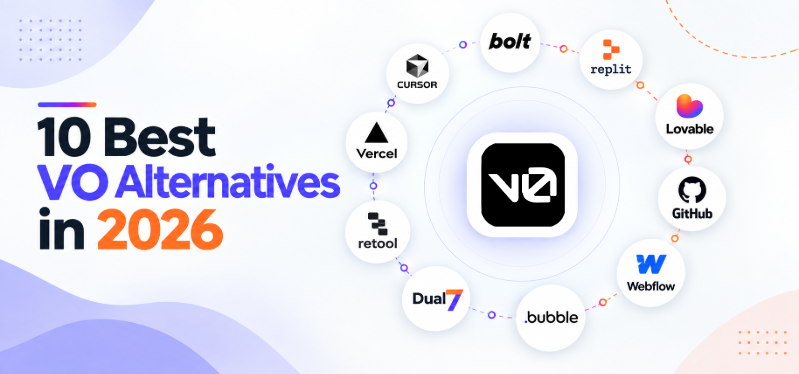
- The best V0 by Vercel alternatives for 2026 include Dual7, Lovable AI, Cursor, Claude Code, Windsurf, Bolt.new, Replit, Base44, Google AI Studio, and Balsamiq. Each one is good at something different. Some build fast. Some let you keep your code. Some are ready for real use right away.
- Dual7 is an AI app builder with rules built in. You build fast with prompts, then move your app through a checked, step-by-step path to production — all on one codebase. It fills the gap V0 leaves open.
- Lovable AI and Cursor fit different skill levels. Lovable AI is built for people who don't code, and it gives you a working backend too. Cursor is built for engineers who already write code every day.
- Claude Code and Windsurf work well no matter what setup you already have. Claude Code is a terminal tool for real, existing code. Windsurf is a VS Code tool for teams who need to work across many files at once.
Millions of frontend developers, designers, and solo builders use V0. It is one of the best options out there to turn a prompt or a screenshot into a React component almost instantly. But many of these same builders hit the same wall: the frontend V0 builds for you is also the only part it will ever touch. Teams move past that first component. Then they need a real database, real logins, and a real backend. And then the issue becomes: what tools can help my team build the rest of the app? In this article, we cover the best V0 alternatives, and what each one is good for.
What is V0, and who is it actually for?
V0 is Vercel's generative UI sandbox that turns natural-language prompts, screenshots, and wireframes into production-grade React, Next.js, Tailwind CSS, and shadcn/ui components. In doing som it can deploy straight into Vercel's serverless edge network but without a native database, authentication layer, or backend of its own. V0 launched out of Vercel and has become a top tool for building frontend screens made for the Next.js and React world.
- V0's biggest strength is how good its designs look: it turns prompts, screenshots, and wireframes into clean, reusable components, and it even changed its name from v0.dev to v0.app in early 2026 as it grew past plain UI work.
- But it hits a wall fast. The moment a project needs a database, a login system, or a backend outside of Vercel, V0 can't help.
- Credits can run out fast, too. A few big requests can burn through the free plan and push you onto a paid one before you're ready.
Top 10 V0 alternatives in a gist
Here's a quick-scan summary of each of the V0 alternatives before the detailed breakdown below.
1. Dual7
Dual7 is an AI app builder with guardrails. Use Vibe Mode to build fast with prompts, then send your app through Governed Mode, a seven-step approval process, so it moves toward production without a rebuild.
| Pros | Cons |
|---|---|
| – Full code and infrastructure ownership from day one – Enterprise controls (SSO/SAML, SCIM, RBAC, row-level security) built in | – Still in early access, with a smaller ecosystem – Backend runs on Dual7's managed cloud runtime unless self-hosted |
2. Lovable AI
Lovable AI turns your prompt into a full app. This v0 alternative builds a clean React and Tailwind CSS frontend, and it builds a real Supabase backend to go with it. You get a working, hosted app in minutes, not just a component.
| Pros | Cons |
|---|---|
| – Full GitHub code export with automated database schemas and auth – Token-free Visual Editor for quick styling changes | – Credit consumption can spike during design iteration or debugging loops – Default UI aesthetics can converge toward a generic look across projects |
3. Cursor
Cursor is a code editor built for engineers. This alternative to v0 is an equal split of VS Code with AI built in, made for people who already have code and want an AI that understands it. This is not to confused with a vibe coding tool that builds an app from a blank prompt.
| Pros | Cons |
|---|---|
| – Zero vendor lock-in — code lives on local drives and standard Git repos – Handles multi-gigabyte codebases without performance degradation | – Requires programming knowledge; it's an editor, not an app generator – Fast-request quotas can require queueing during peak hours |
4. Claude Code
Claude Code is a coding assistant that lives in your terminal. Anthropic built it to work right inside your own code and your own servers, instead of inside a managed sandbox.
| Pros | Cons |
|---|---|
| – Works on real, existing codebases, not just greenfield prompts – No platform lock-in; code, database, and hosting stay entirely up to you | – No graphical interface or visual preview canvas – Strict rate limits on lower tiers during long sessions |
5. Windsurf
Windsurf is an AI code editor built on VS Code by Codeium and Cognition. Its Cascade engine sits between simple autocomplete and full AI control of your code, tracking many files at once.
| Pros | Cons |
|---|---|
| – Near-zero learning curve for existing VS Code users – Cascade tracks multi-file dependencies accurately during refactoring | – No instant web-app scaffolding or visual generation canvas – Daily execution quotas can create friction on long agent sessions |
6.Bolt.new
Bolt.new runs real code right in your browser. This v0 by Vercel alternative uses WebContainers to run a full Node.js setup, and you can see every file, every log, and every package it installs.
| Pros | Cons |
|---|---|
| – Near-instant compilation and hot reload with zero network latency – Full code transparency and GitHub/OSS export | – Token consumption scales sharply with project size – Tends to rewrite entire files even for small fixes |
7. Replit
Replit is a cloud coding platform with an AI agent built in. The agent plans your app, writes the code, sets up a database, and deploys it, all on Replit's own servers.
| Pros | Cons |
|---|---|
| – Handles hosting, backend databases, and code generation in one platform – Supports virtually any language, plus native iOS/Android companion runtimes | – Agent runs on complex builds can burn through monthly allocations fast – Vendor lock-in to Replit's hosting infrastructure |
8. Base44
An all-in-one vibe coding builder, now part of Wix, that bundles frontend generation, a managed database, authentication, and hosting into a single subscription.
| Pros | Cons |
|---|---|
| – Fastest path to a fully hosted product for non-coders – Multi-model routing across Claude, GPT-5, and Gemini Pro | – Severe backend lock-in; only the frontend exports to GitHub – Struggles with complex, multi-step business logic as apps grow |
9. Google AI Studio
Google DeepMind's web-based prototyping environment for the Gemini model family, built for API design, structured prompts, and function-calling — not visual UI generation.
| Pros | Cons |
|---|---|
| – Extremely generous free tier with up to a 2-million-token context window – Fast, reliable, backed by Google's global infrastructure | – No frontend component generation or web hosting at all – Free-tier prompts may be used for model quality improvement |
10. Balsamiq
A low-fidelity, non-AI wireframing tool that intentionally limits visual detail so teams can nail down layout and interaction hierarchy before writing any code.
| Pros | Cons |
|---|---|
| – Zero learning curve; assemble a usable wireframe in minutes – Keeps early planning focused on structure, not visual polish | – No AI generation or code export of any kind – Wireframes must be manually rebuilt in a tool like V0 for development |
Why should you look for a V0 alternative?
V0 popularized generative UI, but its frontend-only architecture creates a few recurring problems once teams move past the first component. This makes looking for V0 alternatives ideal if you want to:
- To avoid the backend gap: V0 connects to external REST/GraphQL APIs and Vercel KV, but it doesn't provision a database, authentication flow, or server-side logic the way Lovable AI, Bolt.new, Base44, or Dual7 do automatically.
- To move away from Vercel/Next.js lock-in: V0's output is tuned specifically for the Next.js, React, and Tailwind stack, so teams building on other frameworks, or wanting a fully portable multi-service backend, need a platform-agnostic tool instead.
- Solving the components-aren't-a-product barrier V0 has: A polished React component isn't a hosted application. Something still has to wire up the database, authentication, and deployment pipeline before a V0-generated interface becomes a real product — and independent developer estimates put the effective markup on some credit-based alternatives as high as roughly 10x over direct API rates once that wiring starts.
- Unlocking the full technical-maturity spectrum: From governed platforms like Dual7 to professional tools like Cursor, Windsurf, and Claude Code, to fully managed builders like Lovable AI and Base44, teams can match the tool to their actual technical maturity instead of accepting V0's frontend-only ceiling.
Detailed comparison of V0's top alternatives
The best v0 alternatives we've listed below fall into distinct categories rather than one interchangeable group. Dual7 is a top V0 alternative that combines fast AI-assisted building with a governed path to production on the same codebase. Cursor, Windsurf, and Claude Code are professional-grade tools for engineers who already ship software and just need the backend V0 won't build. Lovable AI, Bolt.new, Replit, and Base44 package the whole stack — frontend, backend, and hosting, but each handles code ownership differently.
| Platform | Pricing | Main functionality | Best for | Main drawback |
|---|---|---|---|---|
| Dual7 | Free + Paid from $10/month | Governed AI app building | Startups needing a path to production | Newer tool |
| Lovable AI | From $25/month | Prompt-to-app generation | Non-technical founders wanting a hosted backend | Credit usage can spike |
| Cursor | From $20/month | AI-native IDE | Professional engineering teams | Not an app builder |
| Claude Code | From $20/month | Agentic terminal coding | Engineers extending existing codebases | No visual canvas or hosting |
| Windsurf | Free; Pro $15–$20/month | Agentic VS Code IDE | Enterprise teams already on VS Code | No instant app scaffolding |
| Bolt.new | From $25/month | Browser-based full stack | Developers wanting transparency | Token burn on debugging |
| Replit | Free; Pro $25/month | Cloud dev environment & agent | Rapid prototypes & hackathon teams | Unpredictable credit burn |
| Base44 | From $16/month | All-in-one vibe-coding builder | Non-technical founders wanting a hosted app fast | Severe backend lock-in |
| Google AI Studio | Free; usage-based API | LLM API prototyping | Backend engineers testing Gemini models | No frontend generation |
| Balsamiq | From $9/month | Non-AI wireframing | UX teams during early discovery | Zero code output |
1.Dual7
Dual7 is built for teams who like V0's speed, but need more than a component. They need a database, a login system, and a real path to production.
This V0 alternative runs two modes on one codebase. Vibe Mode lets you build fast with prompts. Governed Mode runs your app through seven checkpoints before it goes live. The code stays the same the whole way through: React, Node.js, and PostgreSQL.
Best for: Startups and teams with strict rules, who want V0's speed but need a checked, safe path to production.
- Two modes, one codebase: Move between fast Vibe Mode building and Governed Mode's step-by-step checks, all without starting over.
- You own your code: Your app runs on your own Git account, your own database, and your own cloud. You can export the source code from day one.
- Web and mobile, together: Build Next.js web apps and native iOS and Android apps with Expo, all from one PostgreSQL backend.
| Pros | Cons |
|---|---|
| - You can go from a fast prototype to a tested, production-ready app without a rewrite – Tools like SSO, SCIM, RBAC, and row-level security come built in, not bolted on later | – It's still new, so its ecosystem is smaller than tools that have been around for years |
2. Lovable AI
Lovable AI started as an open-source project called GPT Engineer. It grew into a Swedish company. In December 2025, it raised $330 million, led by CapitalG and Menlo Ventures. The company is now worth $6.6 billion. This V0 alternative builds a clean React, TypeScript, and Tailwind CSS frontend, paired with a real Supabase backend: database, login, edge functions, and storage. You control the infrastructure. This closes the gap V0 leaves open.
Best for: Non-technical founders building a real SaaS product, who need a working backend without hiring engineers first.
- Automated full-stack generation: React and Tailwind CSS frontend combined with an automatically provisioned Supabase backend, including database schemas, auth flows, and CRUD operations.
- Bi-directional GitHub sync: Edit the generated repository locally while staying in sync with the Lovable Agent.
- Token-free Visual Editor: Adjust colors, spacing, and layout without spending generation credits.
| Pros | Cons |
|---|---|
| – Full GitHub code export with an automated Supabase backend – Token-free Visual Editor for quick styling changes | – Credit consumption is unpredictable during long debugging loops – Default UI aesthetics converge toward a generic look across projects |
3. Cursor
Cursor isn't trying to be V0. It's an AI-native fork of VS Code built for professional engineers who already have a codebase and want an AI layer that understands it. Cursor indexes entire repositories to make precise, multi-file changes rather than generating an app from a blank prompt, which makes it the natural next step once a V0 component needs a real backend behind it.
Best for: Professional software engineers who need to wire up the backend V0 doesn't provide, inside a codebase they already maintain.
- Codebase-aware editing: Vectorized repository indexing retrieves precise context across thousands of local files.
- Agentic workspace mode: Executes autonomous multi-file edits, terminal commands, and test runs based on compiler output.
- Model flexibility: Integrates with OpenAI and Anthropic Claude models so teams aren't locked into a single provider.
| Pros | Cons |
|---|---|
| – Zero vendor lock-in: code lives on local drives and standard Git repositories – Handles multi-gigabyte codebases without performance degradation | – Requires programming knowledge; it's an editor, not an all-in-one app generator – Fast-request quotas can require queueing during peak hours |
4. Claude Code
Claude Code takes a fundamentally different route from V0: instead of generating a component inside a browser sandbox, it's an agentic coding tool that lives in the terminal and works directly on your own codebase and infrastructure.
Built by Anthropic, this V0 alternative is aimed at developers who want an AI collaborator that can plan, write, and execute the backend and database work a V0-generated frontend still needs.
Best for: Engineers who need to build the backend, tests, and infrastructure around a V0-generated frontend without leaving the terminal.
- Terminal-native agent: Reads a codebase, plans multi-step changes, and executes shell commands and file edits directly.
- Deep MCP integration: Connects to local build tools, external databases, and developer utilities via the Model Context Protocol.
- Large context, cached cheaply: Context windows up to 200,000 tokens standard, with prompt caching cutting repeat-session costs by up to 90%.
| Pros | Cons |
|---|---|
| – Works on real, existing codebases rather than only greenfield prompt-to-app projects – No platform lock-in: code, database, and hosting choices remain entirely up to the developer | – No graphical interface or visual preview canvas, so it can't replace V0 for design work – Strict rate limits on lower subscription tiers during long sessions |
5. Windsurf
Windsurf is an agentic IDE developed by Codeium in partnership with Cognition, built on a fork of Visual Studio Code. Its Cascade AI flow engine bridges the gap between passive autocomplete and fully autonomous codebase modification.
Best for: Enterprise engineering teams already living in VS Code who need multi-file backend and infrastructure work V0 can't touch.
- Cascade engine: Continuously indexes local codebase context, tracks cursor focus, monitors terminal output, and plans multi-file modifications.
- Broad language support: Supports 70+ programming languages with full compatibility with the VS Code extension marketplace.
- Native VS Code interface: Combines file tree navigation with inline AI diffs and a side-panel agent terminal chat.
| Pros | Cons |
|---|---|
| – Near-zero learning curve for anyone already using VS Code – Cascade tracks multi-file dependencies accurately during complex refactors | – No browser-hosted visual design sandbox to replace V0's generation canvas – Daily usage quotas can create friction during prolonged agent sessions |
6. Bolt.new
Bolt.new, built by StackBlitz, runs full Node.js environments directly inside the browser using WebContainers technology. That said, A Reddit user in r/SideProject reported exhausting an entire month of Pro tokens in three days while stuck looping on auth and database issues using Bolt.new. Where V0 hands you a clean, isolated component, this V0 alternative gives developers full visibility into terminal logs, package installs, and directory structures while generating a complete, running application from a prompt.
Best for: Developers who want a transparent, in-browser full-stack environment rather than V0's frontend-only sandbox.
- In-browser Node.js runtime: Executes npm packages, terminal commands, and dev servers without local setup.
- Framework flexibility: Supports React, Vue, Svelte, Astro, and Next.js projects, beyond just the Next.js stack V0 targets.
- Supabase integration: Pairs generated frontends with a managed backend, then deploys via Netlify or bolt.host.
| Pros | Cons |
|---|---|
| – Full file-system access and transparency appeal to developers who don't want a black-box builder – Zero vendor lock-in; projects export cleanly to GitHub or a local drive | – Token consumption can climb quickly on large codebases or extended debugging sessions – Tends to rewrite entire files even for minor bug fixes |
7. Replit
Replit takes the opposite approach from a terminal tool: everything happens inside a browser-based cloud IDE, including the virtual machine your app runs on. This V0 alternative plans, codes, tests, and deploys full-stack applications on managed cloud infrastructure, making it a strong fit for teams that want V0's zero-setup feel extended across the whole stack. Replit has a 4.5 out of 5 rating on G2 across more than 408 verified reviews, with developer sentiment consistently praising its ability to handle hosting, databases, and code generation
Best for: Rapid prototyping and internal IT teams that want a fully managed, browser-based build-and-deploy workflow.
- Managed cloud VMs: Every project runs on a hosted virtual machine with attached PostgreSQL databases and deployment built in.
- Autonomous agent loops: Installs dependencies, configures authentication, writes application logic, and performs automated fixes based on error logs.
- Mobile support: Native iOS and Android companion runtimes extend a project beyond the web.
| Pros | Cons |
|---|---|
| – Handles hosting, backend databases, and code generation in a single platform – High reliability for running applications directly in the cloud | – Complex full-stack builds can burn through monthly agent allocations quickly – Vendor lock-in to Replit's own hosting infrastructure |
8. Base44
Base44 is an all-in-one AI web application generator that was acquired by Wix for approximately $80 million.
Best for: Non-technical founders who want the fastest path to a fully hosted product, and are willing to accept backend lock-in as the tradeoff.
- Multi-model routing: Lets users select the underlying AI provider, including Claude Opus/Sonnet, GPT-5, and Gemini Pro.
- Full-stack automation: Automatically builds backend database schemas, manages session authentication, provisions file storage, and handles deployment.
- Cost-saving Discuss Mode: A lower-cost planning mode for architecture discussion before triggering a full code-generation prompt.
| Pros | Cons |
|---|---|
| – Fastest path to a complete, hosted product for non-coders – Multi-model routing across leading frontier models | – Backend and database stay bound to Base44 infrastructure permanently – Struggles with intricate state logic as applications grow more complex |
9. Google AI Studio
Google AI Studio is a web-based prototyping environment for experimenting with the Gemini model family. Google AI Studio is v0 alternative that outputs structured JSON data and SDK code snippets for server-side integration instead, making the two tools complementary rather than competing. This is an API design sandbox for multimodal prompts, system instructions, structured JSON responses, and function calling before deploying to Vertex AI.
Best for: AI engineers and backend developers who need to prototype the server-side logic behind a V0-generated frontend.
- Model access: Direct access to the Gemini model family, with text, image, audio, and video input support.
- Massive context windows: Up to 2,000,000 tokens, enough to ingest entire code repositories or documentation sets.
- SDK export: Client SDK code in Python, JavaScript, cURL, and Swift, alongside configurable model parameters.
| Pros | Cons |
|---|---|
| – One of the most generous free-tier API sandboxes available – Massive context window supports full repository or documentation analysis | – No interactive visual interface generation or web frontend hosting – Free-tier data may be used to improve Google's models |
10. Balsamiq
Balsamiq falls under the category of generative AI builders, limiting visual detail so product managers, UX designers, and stakeholders can focus on layout and user flow before any code is written. Balsamiq is a V0 alternative that helps teams iterate on structural user flows before development.
Best for: UX designers and product teams who want to lock down layout and flow before generating any code at all, including with V0.
- Sketch-style UI library: Pre-built controls (buttons, forms, navigation bars, modals) styled to resemble hand-drawn sketches.
- Collaboration and integrations: Cloud collaboration features, native desktop execution, and integrations with Google Drive, Jira, and Confluence.
- Zero learning curve: A drag-and-drop interface that lets non-designers assemble functional wireframes within minutes.
| Pros | Cons |
|---|---|
| – Zero learning curve for assembling a usable wireframe – Keeps teams focused on structure instead of premature visual polish | – No AI generation or production code output of any kind – Wireframes must be manually recreated in a tool like V0 for development |
How to choose the right V0 alternative for your team
To avoid switching to a tool with the same hidden problems, check each alternative against four things:
- Code and server ownership: Do you need full access to your frontend and backend code? Or is a hosted setup fine? Dual7, Cursor, Claude Code, and Windsurf all give you full or near-full control.
- Your team's skill level: If your team can't code, Lovable AI, Base44, or Dual7's Vibe Mode are the easiest step up from V0. If your team already codes, Cursor, Windsurf, and Claude Code will help more.
- How ready you need to be for production: If your app needs to pass strict security checks, use a tool like Dual7, or a strong editor like Cursor or Windsurf.
- How steady your costs need to be : Compare flat monthly plans against pay-as-you-go credits. Dual7's BYOK pricing and Claude Code's direct API billing help you dodge the surprise bills that come with credit-based tools like Lovable AI, Bolt.new, and Base44.
Dual7: The Best V0 Alternative Overall
Of all the tools on this list of best v0 alternatives, Dual7 creates the clearest path from a V0-style prompt to a finished, working app. As a vibe coding tool, its biggest strength is this: speed, ownership, security, and rules all live in the same process. It doesn't stop at the component, the way V0 does.
- Build fast, ship right: Dual7 mixes fast AI building with a checked, step-by-step path to production.
- Keep your code: Your app comes as clean React, Node.js, and PostgreSQL code. Export it to GitHub and run it wherever you want.
- Security built in: Multi-tenancy, row-level security, RBAC, and secret protection are part of the process, not extras.
- Human-signoff checkpoints: A human signs off at each stage: requirements, design, screens, database, testing, and launch. This cuts down on risky AI mistakes.
- Web and mobile: One codebase builds Next.js web apps and native iOS and Android apps through Expo.
Ready to build a complete enterprise ready app? See what Dual7 can do for your team !
Frequently Asked Questions
Frequently asked questions
What is the best free V0 alternative?
When it comes to free V0 alternatives Google AI Studio has the best free plan for backend work, though it won't build you a frontend. For full apps, Dual7, Lovable AI, Bolt.new, and Base44 all have free plans good enough to test with.
Can V0 give me a working backend?
No, not on its own. V0 can connect to outside APIs, but it won't build you a database, a login system, or backend logic. You'll need a separate tool for that, like Dual7, Lovable AI, Bolt.new, or Base44
Which alternative is best for non-developers who want to keep their code?
Lovable AI and Dual7 are your best V0 alternatives for non developers. Both let you build a full app using plain English, and both let you export clean, standard code to GitHub and your own database.
How does Dual7 differ from other full-stack alternatives to V0?
Dual7 combines fast, prompt-based building Vibe Mode with a seven-step approval process Governed Mode, all on the same codebase. Your app can go from a V0-style prototype to a production-ready product, without a rewrite.
Article Authors

More posts from this author
Related posts